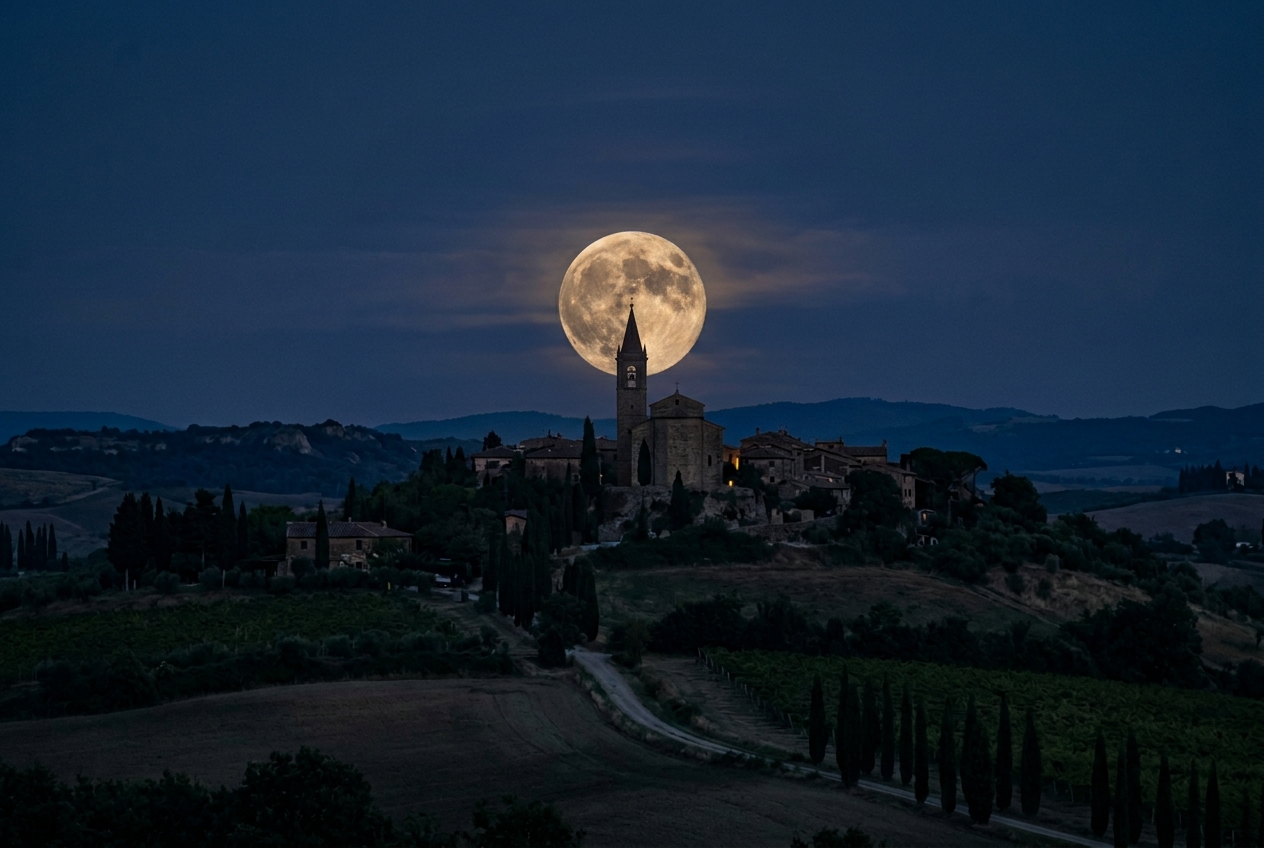
Full Moon Silhouette

German: Vollmond-Silhouette

A near-full moon rising or setting at the horizon with a subject silhouetted inside the disk.

Full Moon Silhouette - photography example

When a full (or near-full) moon rises or sets right at the horizon while the sky is already dark, the enormous moon disk becomes a natural backdrop for silhouettes. Photographers position themselves far from a well-known landmark - a church spire, a lone tree, a person on a ridge - so that a telephoto lens compresses the subject against the moon. The result: a tiny, sharp silhouette framed inside the massive glowing circle.

Inverza checks moon illumination (greater than 85%, covering the full moon plus or minus 2 nights), confirms the sun is at least 4 degrees below the horizon (blue hour or darker), and verifies the horizon is clear of cloud cover. The condition fires at the exact moment of moonrise or moonset - whichever scores higher - and includes the precise compass direction so you know where to position yourself. This uses terrain-adjusted times because you need to know when the moon physically clears the terrain at your location.

Tip: Distance is everything. Stand far from your subject (1-3 km) and use a long telephoto (200-600mm). The farther you are, the larger the moon appears relative to the silhouette. Use Inverza's map with moonrise direction lines to plan your exact position.

Frequently asked

How far should I stand from my subject?

1-3 km at a focal length of 200-600mm. The farther you stand, the larger the moon appears relative to the subject because telephoto compression flattens the distance between them.

When does a full moon silhouette work best?

At moonrise or moonset on the nights around the full moon, during blue hour or later. Inverza picks the better of the two events and gives you the exact time and compass bearing.

Inverza detects every condition above automatically. Set your location and get notified when something special is coming.

Download on the App Store