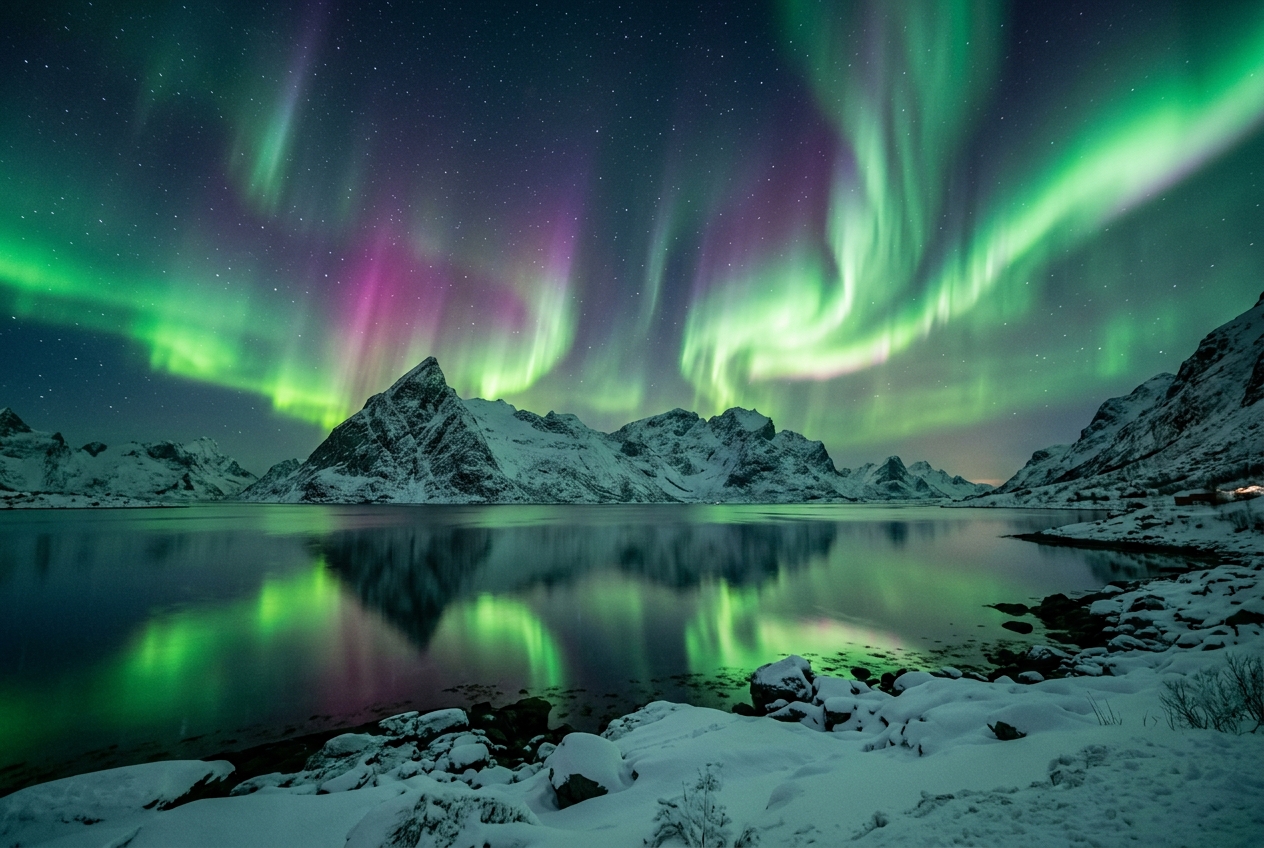
The northern lights are among the most spectacular natural phenomena a photographer can capture. They occur when charged particles from the sun interact with Earth's magnetic field and atmosphere, creating curtains and waves of green, purple, and pink light dancing across the sky.
Inverza uses the Kp geomagnetic index (adjusted for your latitude - higher latitudes need lower Kp values) and cloud cover (must be below 30%) as the core gates. At mid-latitudes, you need a strong geomagnetic storm (Kp 5+) to see aurora; near the Arctic Circle, Kp 2 can be enough.
Strict civil-twilight darkness (v1.5+)
The darkness check now requires the sun to be at least 12 degrees below the horizon (the end of nautical twilight), not just below the geometric horizon. In sub-Arctic latitudes during shoulder seasons this can mean detections start 30 to 90 minutes later than they used to - but those extra minutes are precisely when the sky is too bright for aurora to be visible anyway. The badge timing now matches what your camera will actually capture.
Light-pollution awareness (v1.5+)
From version 1.5, aurora detection factors in the local Bortle class of the saved spot, derived from a global VIIRS satellite light-pollution raster bundled with the app (the same data source the Milky Way detector uses). The penalty ladder is milder than for the Milky Way because aurora is intrinsically much brighter than the galactic core - the May 2024 G5 storm was photographable from London suburbs.
Bortle 1 through 4 takes no penalty: the aurora photographs as well as the storm itself allows. Bortle 5 through 8 takes a graduated subtraction, biggest in the urban band. Bortle 9 (inner city) is hard-gated: even a once-in-a-decade G5 storm would lose its photographic value in central Tokyo or Manhattan. The detector also applies a strong-storm modulation: when the Kp value sits two full points above your location threshold, the Bortle penalty is halved. Bright displays punch through suburban sky glow, and the algorithm acknowledges that.
The reason text and the badge caveat tell you the local Bortle class and, for marginal events at light-polluted spots, what storm strength you would need to make the trip worthwhile.