In this story

If you opened Inverza in the last few days and saw the Milky Way detector score above zero for the first time since last September, that is not a bug. The galactic core is back.
For European photographers, that is a bigger deal than it sounds.
Why the core disappears for half the year
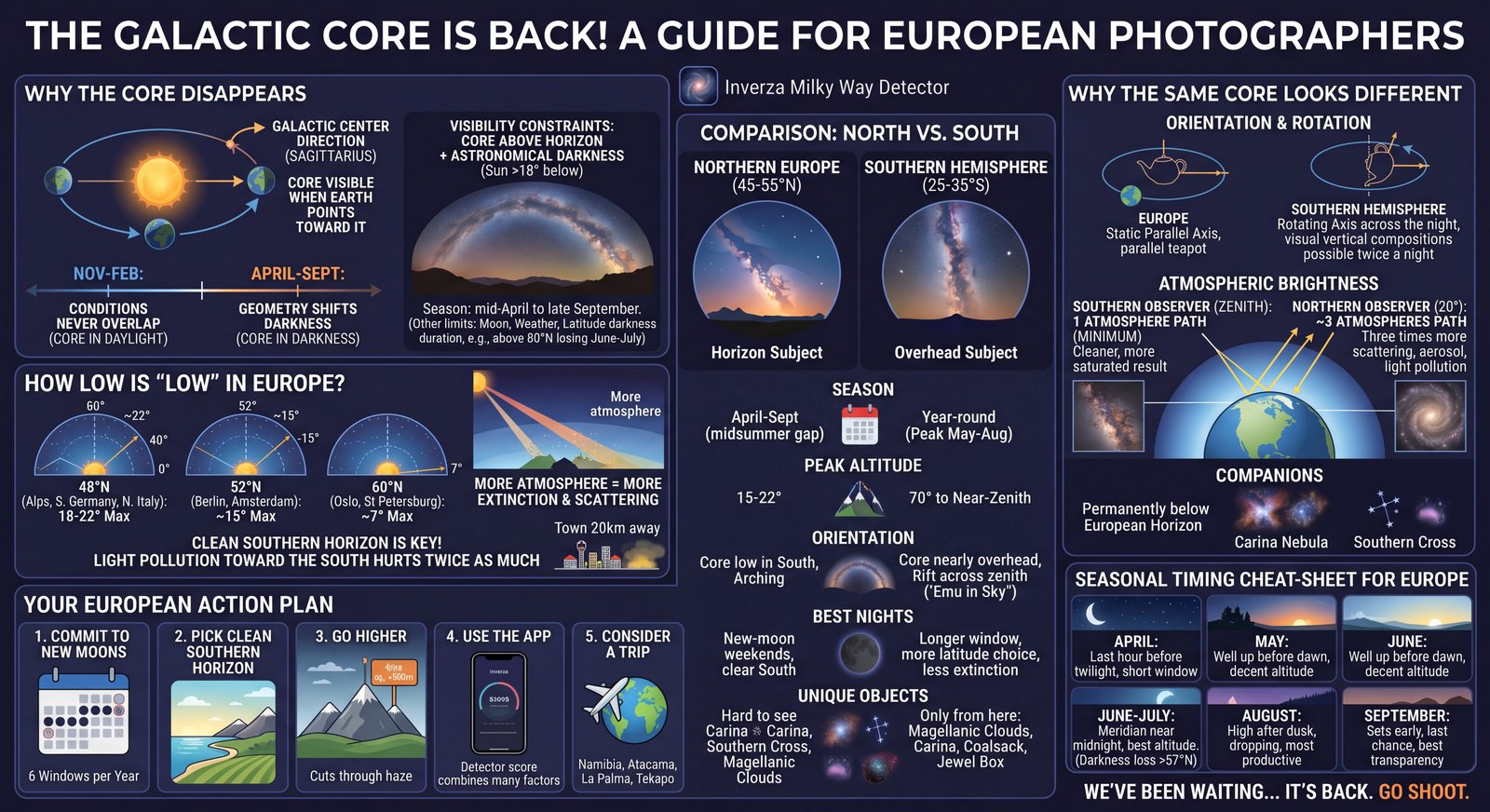
The bright, textured part of the Milky Way that photographers chase - the galactic center in the constellation Sagittarius - sits roughly 26,000 light-years away in a direction that the Earth points toward only when the Sun is on the opposite side of our orbit. That happens once a year, and the window we get to see it in a dark sky is constrained by two things: the core has to be above the horizon, and the Sun has to be at least 18 degrees below it (the definition of astronomical darkness).
From November through February in Europe, those two conditions never overlap. The core is in the sky, but only during daylight. From early April, the geometry finally shifts: the core starts rising late at night in the southeast, still low, but above the horizon during true darkness. By late April and May it is already visible at a reasonable altitude before dawn. By June and July it crosses the meridian in the middle of the night. By September, it sets earlier and earlier, and by October it is done again.
That gives most of Europe a Milky Way season of roughly mid-April to late September. Inside that season, the number of usable nights is limited further by the Moon (new-moon windows), by weather, and by how long it stays dark at your latitude. Above 60°N, astronomical twilight never ends in midsummer - you lose June and most of July entirely.
How low is "low", exactly
From a typical central-European latitude of 48°N (the Alps, southern Germany, northern Italy), the galactic core rarely climbs above 18-22 degrees of altitude at its meridian transit. From 52°N (Berlin, Amsterdam) it peaks around 15 degrees. From 60°N (Oslo, St Petersburg) it barely clears 7 degrees - if it is visible at all during the brief window of darkness.
Low altitude means more atmosphere to shoot through. More atmosphere means more extinction, more scattering, and a much stronger dependency on how clean the southern horizon is. Light pollution toward the south hurts twice as much as light pollution overhead. A town twenty kilometres away in the wrong direction can kill the image.
What the southern hemisphere sees
Drop down to 33°S - Sydney, Santiago, Cape Town - and the same galactic core passes nearly directly overhead. At some latitudes in the southern tropics it even transits at the zenith. The core is no longer a horizon arch: it is a ceiling. That changes everything.
Northern Europe (45-55°N)
- Season: April to September, gap in midsummer at high latitudes.
- Peak altitude: 15-22° above the horizon at meridian.
- Orientation: Core sits low in the south, arching above a southern horizon.
- Best nights: New-moon weekends April-September with a clear southern view.
- Hard to see: Large Magellanic Cloud, Small Magellanic Cloud, Carina Nebula, Alpha/Beta Centauri, the Southern Cross.
Southern hemisphere (25-35°S)
- Season: Effectively year-round, with peak altitude in May-August (their winter).
- Peak altitude: 70° to near-zenith at meridian.
- Orientation: Core nearly overhead, rift running across the zenith; "Emu in the Sky" dark lane visible end-to-end.
- Best nights: Longer window, more latitude choices, less atmospheric extinction.
- Only-from-here: Magellanic Clouds, Carina, Coalsack, Jewel Box, full length of the core.
Why the same core looks different
The orientation is the big one. From Europe, Sagittarius rises in the southeast, climbs to the south, and sets in the southwest. The brightest region - the teapot and the bulge above it - sits almost parallel to the horizon on a horizontal axis. From the southern hemisphere, the same region rises in the east, passes overhead, and sets in the west. The core rotates as it crosses, so its axis points in every direction across the night. Compositions that only work once a season in Europe - like the core standing vertical above a peak - happen twice a night in Patagonia.
The brightness difference is not the core itself, which is the same object. It is the column of air you are looking through. A southern observer at the zenith is shooting through one atmosphere's worth of air (the minimum). A northern observer with the core at 20° is shooting through nearly three. That is three times more molecular scattering, three times more aerosol, three times the path through any low-lying light pollution. The same camera settings produce a visibly cleaner, more saturated result south of the equator.
And then there are the companions. The Large and Small Magellanic Clouds, two satellite galaxies of the Milky Way, are never visible from Europe. The Carina Nebula, probably the brightest emission nebula in the sky, never rises for us. The Southern Cross, Omega Centauri, the Coalsack dark nebula - all of it is permanently below the European horizon.
What to do with all this from a European sofa
You can shoot a great Milky Way image from Europe. You just have to plan like it matters, because it does. A few things we recommend:
- Commit to new-moon weekends. Milky Way season gives you roughly six new-moon windows per year in Europe. Put all of them on the calendar before anything else.
- Pick a site with a clean southern horizon. Mountains, coastlines, open fields facing south. Any obstruction cuts into the most valuable part of the sky.
- Go higher. Even 500 m of elevation cuts meaningfully through haze and aerosol. The Alps, the Dolomites, the Pyrenees, the Canaries, and the Scottish highlands are all disproportionately good for European Milky Way work.
- Use the app. The Milky Way detector in Inverza already combines sun depression, moon phase and altitude, cloud cover, humidity, and the core's own altitude for your location. It will tell you which hour on which night of which new-moon weekend is worth setting the alarm for.
- Consider a trip. If you have ever looked at astrophotography from Namibia, La Palma, Atacama, or Tekapo and wondered why nothing you shoot at home looks remotely like it - this post is your answer. One week under a southern sky during a new moon will produce material that is simply not reachable from the north.
Seasonal timing cheat-sheet for Europe
- April: Core visible only in the last hour before astronomical twilight. Low, very short window.
- May: Core well up before dawn, decent altitude from mid-latitudes.
- June-July: Core crosses the meridian near midnight; best altitude of the season. Caveat: latitudes above ~57°N lose darkness.
- August: Core high right after dusk, dropping through the night. Warm, stable nights make this the most productive month.
- September: Core sets early. Last chance until April. Often the best month for transparent air.
We have been waiting six months. It is back. Go shoot.